|
Thomas J. Dodd Prize
|
![]() |
Biography | Speech | ![]() |
|
| The Center for Justice & Accountability accepted by Pamela Merchant |
Mental Disability Rights International accepted by Eric Rosenthal & Laurie Ahern |
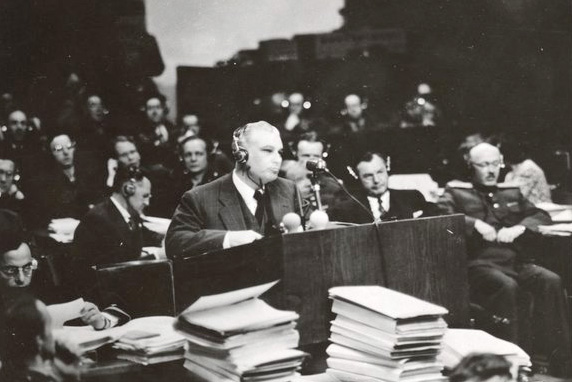
In less than ten years, the Center for Justice and Accountability (CJA) has made a major impact on the human rights movement by bringing perpetrators of human rights abuses to justice and providing redress to victims of human rights abuses from around the world. CJA was founded to help survivors of torture and other severe human rights abuses hold their perpetrators accountable in the courts. CJA's work is based on the doctrine of universal jurisdiction, first used in the Nuremberg trials, which holds that certain crimes are so egregious that they represent offenses against all humankind and that perpetrators of such crimes should be held accountable wherever they are found.
In its short history, CJA has brought cases against human rights abusers from Bosnia, Chile, China, El Salvador, Guatemala, Haiti, Honduras, Indonesia, Peru and Somalia. CJA pursues civil cases in the U.S. using two laws that provide protection for torture survivors; CJA also pursues criminal cases in the Spanish court system which has initiated prosecutions into abuses around the world. To date, CJA has received favorable verdicts in all of their cases that have gone to trial.
CJA won the first jury verdict in U.S. history for crimes against humanity in a contested case involving the Caravan of Death in Chile. The Center recently secured landmark victories for asset collection in human rights litigation, freezing nearly $1 million that a former Haitian military officer won in the Florida State Lottery and collecting over $300,000 from the former Salvadoran Minister of Defense.
CJA's cases seek to deter torture by showing human rights abusers that they will be held accountable if they travel to other jurisdictions. They also serve as catalysts for efforts to seek justice in the home country by showing that it is possible to be successful in court against those once thought to be above the law.
CJA Acceptance Remarks
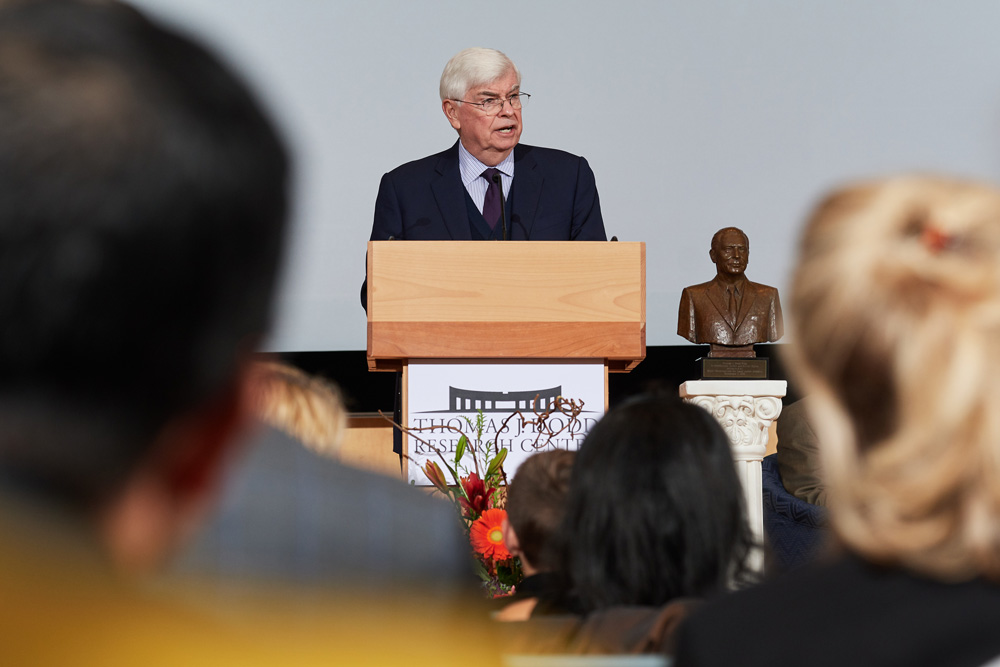
Remarks of Pamela Merchant, Executive Director, The Center for Justice and Accountability, October 1, 2007
Thank you Senator Dodd, President Hogan, Barbara Kennelly, Tom Wilsted, and, of course, Thomas J. Dodd.
CJA is extremely honored to receive this prestigious award and to be included among the visionaries and leaders who have received this award in the past.
I would also like to congratulate our co-awardee Eric Rosenthal, Laurie Ahearn and Mental Rights Disabilities International. We are great admirers of your work and are so pleased to share this prize with you.Senator Dodd, I found your remarks about your father and his generation, and their efforts to extend the rule of law particularly inspiring. When I received the call from Tom Wilstead and learned that CJA had been awarded the Thomas J. Dodd Prize in International Justice & Human Rights -- I had a number of reactions. The first, of course, was one of delight. The second was one of great pride: pride for CJA, our heroic clients, our talented and dedicated staff, our board, and, of course, for all the people who come together to work on our cases: pro bono attorneys, expert witnesses, community and refugee groups in the U.S., and justice and accountability groups in the countries where the human rights abuses occurred.
At the same time, I was struck by the significance of being awarded this prize, which honors the rule of law, at this moment in history when, as Senator Dodd so eloquently stated, our ability to stand up to the rule of men -- in favor of the rule of law -- is being challenged.
I went to law school because I wanted to change the world. Many of us who came of age during the civil rights movement saw the law as a vehicle for justice and social change. The best and highest example of the use of the law as a force for good, in my opinion, was the decision by the victors in World War II to try the worst human rights abusers in history. To use the rule of law to judge them. Instead of summary executions or mobs in the streets.
Nuremberg marked the effective start of the international human rights movement.
CJA is proud to be part of that movement.
The Center for Justice & Accountability is dedicated to ending torture and seeking justice.
We represent torture survivors in cases, brought on their behalf, against human rights abusers. The legal framework for our work is based on principles used for the first time at Nuremberg. Certain crimes are so egregious that they represent offenses against all human kind. These crimes include genocide, crimes against humanity, extrajudicial killing and torture.
The legal framework is also grounded in Universal Declaration of Human Rights which was adopted by the United Nations in 1948. The declaration acknowledges that we, as humans, all have certain rights regardless of our country of origin. Inalienable rights -- as it were.
One of those rights is the right to be free from torture. Another is the right to be free from cruel or degrading punishment. Since 1948, over 144 nations have signed onto the United Nations Convention against Torture. And yet, last year, according to Amnesty International over 100 nations committed acts of torture. Even more ominous, for the first time, our own government has authorized the use of torture.
Why do governments torture and who do they torture? Briefly, governments torture primarily to silence and intimidate and to repress political and religious opposition - real or imagined. The goal is to silence. Myanmar is a current example.
You have heard the argument that torture can be an effective way to get information and prevent another 9.11. The reality of course is the opposite. Every expert will tell you that torture is an extraordinarily unreliable way of gathering information. Certainly, all of our clients will tell you that. In fact, tragically, most of them will tell you that they have "confessed" -- falsely -- to anything just to stop the torture.
Who is tortured? Well, it could be anyone. Nelson Mandela, President Michelle Bachelet of Chile, Elie Wiesel, Mohandas Gandhi, Alexander Solzhenitsyn-- are all torture survivors. It is estimated that well over 500,000 torture survivors live in the United States. Chances are good that if you come in contact with someone from Guatemala, El Salvador, Cambodia, Somalia, Liberia or dozens of other countries, that they are or someone they know is a torture survivor.
There often isn't a clear rhyme or reason to state-sponsored torture. Torture, once introduced into a military command structure, is very difficult to contain. The government in El Salvador, for example, targeted teachers, union members and the Catholic clergy killing, an estimated 75,000 civilians by the end of their civil war. In Guatemala, the focus began with union leaders but then shifted to almost the entire indigenous population. It is estimated that 200,000 Mayans were killed at the hands of government forces.
CJA's cases help survivors experience a sense of justice and meaning in their survival.
Because one of the goals of the torturer is to silence, one of the very important things about our cases is the record they create. This was obviously a very important part of the Nuremberg trials where the world was shown, through the trial, the horror that was the Holocaust.
Our clients are the true heroes in all of this work. They have all come forward to speak the truth and provide a voice to those who cannot speak. They do so often at great risk to themselves and their families in an attempt to put an end to the cycle of human rights abuses.
We are honored to have two of our clients here today, Gloria and Oscar Reyes. The Reyes’s were both plaintiffs in our case against Lopez Grijalba, the former Chief of Military Intelligence of Honduras. In 1982, they both were arrested, tortured for many days, and unlawfully detained for five months. Their only crime was being outspoken members of the intelligentsia in Honduras. Oscar Reyes is a native of Honduras, where he was a journalist and communications professional. He holds a master's degree in communications from the University of Minnesota and was the founder of the School of Journalism at the National University of Honduras. Gloria Reyes is a native of Nicaragua, and an interior designer. The Reyes’s were ultimately exiled to the United States where they have become prominent members of their community in the D.C. area. Mr. Reyes has continued his work as a journalist. Over 25 years after their arrest, just last year, they won their case in a federal court in Miami. This was the first time that a Honduran military leader was held responsible for human rights abuses. Remarkably, the case has sparked a quest for justice in Honduras. The Attorney General there has vowed to prosecute Lopez Grijalba for human rights abuses based, in part, on the Reyes’s case. We are assisting in those efforts.
In conclusion, I would like to come back to the rule of law and Nuremberg. As Jimmy Carter said, " America did not invent human rights. In a very real sense human rights invented America."
Our country's role in pushing for the rule of law after WWI allowed us to assume a rightful place as a moral leader in the international arena. Today, our government has authorized the use of torture in the so-called "war" on terror. From my vantage point as a lawyer, a former federal prosecutor and now speaking for CJA, I can't think of a position my government could take that would be more disturbing. Our challenge, therefore, is to speak out, to break the silence, to end torture in all its forms, and to embrace, once again, the rule of law.
Thank you for your kind recognition of CJA and our work.
Mental Disability Rights International (MDRI) is a unique and effective advocacy organization fighting worldwide for the human rights of people with mental disabilities. Eric Rosenthal, an attorney, founded MDRI in 1993 and is the Executive Director. MDRI's accomplished Associate Director, Laurie Ahern, is a former investigative journalist and a leader of the international psychiatric recovery movement.
MDRI has worked in 23 countries and published reports on the rights of people with disabilities in eight countries – Argentina, Hungary, Kosovo, Mexico, Peru, Russia, Turkey and Uruguay. These reports provide vivid firsthand accounts from mental health experts, institutional staff, and people with disabilities subject to abuse. MDRI's exhaustive reports are supported by powerful photographs and video documentation.
MDRI has brought unprecedented international attention to the inhumane treatment, torture, arbitrary detention, and segregation from society of children and adults with disabilities in orphanages, psychiatric institutions, nursing homes, jails and prisons. Bringing violations to public attention, MDRI has pressured governments to end abuses against their most marginalized and vulnerable citizens. Nurturing, training, and supporting advocacy by people with disabilities and their allies, MDRI has brought about a new worldwide advocacy movement. MDRI has gained support for the first major human rights treaty of the 21 st century – one of the most ambitious human rights instruments ever – the UN Convention on the Rights of Persons with Disabilities.
MDRI has produced startling results. In Turkey, MDRI pressure saved thousands of people from “unmodified ECT” – electro-shock treatment without anesthesia. In Hungary, Kosovo, and Peru, MDRI helped people with psychiatric and intellectual disabilities form organizations to fight for their own rights. MDRI’s report on Mexico found children tied to beds and adults left to languish for years in inactivity and filth. Within months, Mexico closed its most abusive institution and created safe and dignified community alternatives. In Paraguay, MDRI brought an end to life-threatening treatment practices by petitioning the Inter-American Commission on Human Rights. The Commission ordered the release of boys with autism who had been held naked in isolation cells for more than four years. Paraguay then entered into an historic agreement to restructure its entire mental health system. As a consultant to the United States National Council on Disabilities, MDRI authoreda report on discrimination in US foreign assistance and human rights policy. As a result, Congress adopted legislation to make foreign assistance programs accessible to people with disabilities.
This page is maintained by J.Nelson